Symposium
by Plato · Συμπόσιον
Assigned by 7 of the 9 reading lists
- Written
- c. 380 BCE
- Language
- Greek
- Length
- Short · 80 ppunder 120 pages
- Difficulty
- Moderate2 of 5 for a first-year reader
We recommendSymposium, translated by Alexander Nehamas and Paul WoodruffHackett, 1989Lively and precise, with a helpful introduction; the translation most programs assign.
These links go straight to Amazon and Bookshop.org and earn this site nothing today. Prices are the same either way. How this works.
At a drinking party held to celebrate the tragedian Agathon's first victory, the guests agree to skip the heavy drinking and give speeches in praise of Eros instead. Phaedrus, Pausanias, the doctor Eryximachus, the comic poet Aristophanes and Agathon speak in turn, Aristophanes with his fable of humans cut in half and searching ever since for the other piece. Socrates then reports what the priestess Diotima taught him: that love is a lack, a longing to possess the good forever, and a ladder that rises from one beautiful body to Beauty itself. A drunk Alcibiades arrives and, instead of praising love, describes his humiliating failure to seduce Socrates.
Why it's on the list
This is where the West got the idea that desire is a form of knowing. Diotima's ladder turned erotic longing into the engine of philosophy, and it shaped Plotinus, Augustine's restless heart, the poetry of courtly love, Renaissance theories of beauty and the whole modern habit of treating art as a route to something higher. The dialogue also keeps its own rival accounts alive rather than refuting them: Aristophanes' story of the severed halves is still the best description anyone has given of wanting one particular person, and it directly contradicts the ladder. Programs assign it because it is Plato at his most enjoyable and most literary, because it is the one dialogue where the comic poets get their say, and because it ends by putting the philosopher himself on trial as an object of love.
Key themes
- Love and desire
- Eros here is defined by what it does not have. Because it lacks beauty and goodness it pursues them, which makes wanting, not having, the philosophical condition.
- Art and beauty
- Beauty is the one form we meet with our eyes, which is why it can start the ascent. Bodies, laws and sciences are all rungs, and each is left behind.
- Knowledge and truth
- Socrates claims to know nothing except about love, and his entire contribution is secondhand, reported from a woman who is probably an invention.
- Women and men
- The speeches assume a world of male lovers and boys, and then Plato gives the decisive teaching to a female voice and the image of intellectual pregnancy and birth.
- The good life
- Alcibiades' speech asks whether the ascent to Beauty leaves a person able to love anyone in particular. He is the evidence for the prosecution.
Overview
The Symposium is a party recalled at third hand. Apollodorus tells the story to an unnamed companion; he heard it from Aristodemus, who was there; and the party itself took place years earlier, around 416 BCE, when Agathon won the prize for tragedy. Plato was writing perhaps thirty years later, for readers who knew that Alcibiades had gone on to betray Athens and that Socrates had been executed partly for the company he kept. The frame is not decoration. Everything in the dialogue reaches us through affectionate, unreliable memory.
Structurally it is the most elegant thing Plato wrote. Seven speeches in praise of Eros, arranged so that each corrects the one before, followed by an eighth that is not a speech about love at all but a confession about a person. It is also the funniest of the dialogues. Aristophanes gets the hiccups. The doctor prescribes for them. Agathon talks like a bad poet on purpose. Socrates arrives late because he was standing in a neighbour’s porch thinking.
Read it as a competition and a comedy that turns serious without warning.
What happens
Aristodemus meets Socrates, freshly bathed, on his way to Agathon’s and comes along uninvited. Everyone is hung over from the victory celebration the night before, so Eryximachus proposes light drinking and speeches instead.
Phaedrus speaks first: Eros is the oldest god, and he inspires lovers to shameful risk and noble sacrifice. Alcestis died for her husband; Achilles died for Patroclus.
Pausanias distinguishes two Eroses, common and heavenly, and defends the Athenian conventions around older men and younger ones. His speech is essentially a lawyer’s brief for his own arrangements.
Eryximachus, a physician, universalises: love is harmony, in bodies, in music, in seasons, in sacrifice. Medicine and astronomy are branches of erotics. It is confident, systematic and slightly absurd.
Aristophanes tells the myth everyone remembers. Human beings were once double, round, with four arms and four legs, in three sexes: male, female and androgynous. They grew arrogant and Zeus split them like eggs. Ever since, each half has hunted for its other and wants to be welded back. Love is the name for the hunger for wholeness, and our happiness would be to find the piece we lost.
Agathon praises Eros as the youngest and most beautiful of gods, in ornate periods that describe the god’s attributes rather than his effects. Socrates says he is now afraid to speak.
Then the turn. Socrates cross-examines Agathon briefly and gets him to concede that love desires what it lacks, so Eros cannot himself be beautiful or good. He then reports a conversation with Diotima of Mantinea. She taught him that Eros is a daimon between mortal and immortal, born of Poverty and Resource, and that what everyone wants is not beauty but to possess the good forever. Since we are mortal, we get forever by generation: bodies have children, and souls give birth to poems, laws and, best of all, to understanding. She then describes the ascent, which Socrates says she delivered like a mystery initiation: from one beautiful body, to all bodies, to beautiful souls, to institutions and laws, to knowledge, and at last to Beauty itself, which is not in any face or body or argument but is always and only itself. A person who touched that, she says, would be as close to immortal as a human can get.
Alcibiades then crashes the party drunk, garlanded, propped up by a flute girl. Told he must make a speech too, he says he will praise Socrates instead, and by means of images. Socrates is a satyr statue with gods inside. His words are ridiculous on the surface and overwhelming underneath. Alcibiades admits he tried to trade his beauty for Socrates’ wisdom, spent a night under the same cloak with him, and was treated with complete restraint, which he experienced as an insult. He tells how Socrates behaved at Potidaea in the frost and at the retreat from Delium. The point of his speech is that Socrates has looked down the ladder and cannot be captured by anybody. The party dissolves; Socrates argues into the night that one poet should be able to write both tragedy and comedy, and leaves in the morning sober while everyone else sleeps it off.
How to read it
Read it straight through in one go. It takes about two hours, and the shape depends on momentum.
Then reread the three speeches that matter most and set them against each other. Aristophanes says love seeks a particular missing person. Diotima says love seeks the good and uses particular people as rungs. Alcibiades says he loved one man completely and was not loved back. The dialogue does not adjudicate. You have to.
Notice how much of the supposedly mystical teaching is put at a distance: Socrates disclaims it, attributes it to a woman from Mantinea who may not have existed, and delivers it in the vocabulary of religious initiation rather than proof. Ask why Plato took the trouble.
Watch the word for beauty, kalon, which also means fine or noble. English forces a choice the Greek does not make, so compare translations at 210 to 212 if you can. Nehamas and Woodruff is the classroom standard. Jowett is free and stately but Victorian about the homoeroticism, which is not incidental to the argument.
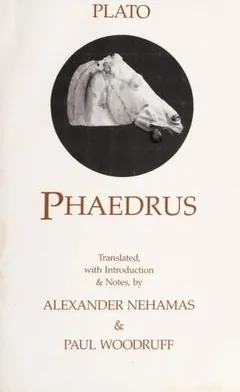
Finally, read it next to the Phaedrus, where Plato gives love a second and quite different treatment, with the soul as a charioteer and madness as a gift.
Questions it raises
- Does Diotima’s ladder describe love, or replace it with something else?
- Can you love a person and love Beauty itself at the same time, or does the ascent require leaving individuals behind?
- Why does Plato give the winning argument to a woman, and to one Socrates says he merely heard?
- Is Alcibiades’ speech a tribute to Socrates or an indictment of him?
- Aristophanes was the comic poet who mocked Socrates in public. Why does Plato give him the most memorable myth in the book?
- If love is the desire for what you lack, what does a satisfied person want?
Highlights
The desire and pursuit of the whole is what we call love.
The conclusion of Aristophanes' fable, and the sentence people quote when they mean something the ladder cannot explain.
Love is not a god and not a mortal, but something in between, a spirit born of Poverty and Resource, always needy, always scheming, never rich and never destitute.
Paraphrase of Diotima's genealogy of Eros, which makes love structurally identical to the philosopher.
Beginning from these beautiful things, he must always climb higher for the sake of that beauty, as if using the steps of a ladder.
Paraphrase of the ascent. Notice that it goes from one body to all bodies to souls to laws to knowledge and finally to Beauty itself.
He is exactly like those hollow statues of Silenus that open up, and inside are figures of the gods.
Paraphrase of how Alcibiades introduces Socrates, ugly on the outside and holding something divine.
When I hear him I am worse off than any Corybant; my heart pounds and tears run out of me, and I have felt this from no other speaker.
Paraphrase. Alcibiades is describing the effect of Socratic conversation as a kind of possession.