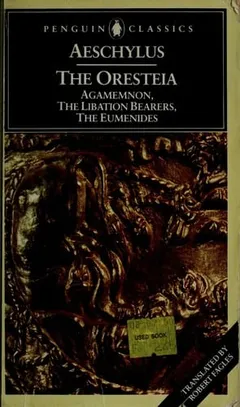
The Oresteia
by Aeschylus · Ὀρέστεια
Assigned by 6 of the 9 reading lists
- Written
- 458 BCE
- Form
- Tragedy
- Language
- Greek
- Length
- Medium · 300 pp120 to 300 pages
- Difficulty
- Demanding3 of 5 for a first-year reader
We recommendThe Oresteia, translated by Robert FaglesPenguin Classics, 1984Vivid and readable, with a long introduction and notes; the trilogy most often assigned in this version.
Also good
- Richmond Lattimore. Closer to the Greek word order and syntax, harder going, the choice if you are studying the imagery.
- Anne Carson. Aeschylus, Sophocles and Euripides combined into one sequence; interesting after you know the original.
These links go straight to Amazon and Bookshop.org and earn this site nothing today. Prices are the same either way. How this works.
The only complete Greek tragic trilogy to survive, first performed in Athens in 458 BCE. In Agamemnon the king returns from Troy and is murdered in his bath by his wife Clytemnestra, in revenge for the sacrifice of their daughter Iphigenia. In The Libation Bearers their son Orestes, commanded by Apollo, returns from exile, meets his sister Electra at their father's grave, and kills his mother and her lover. In The Eumenides the Furies pursue him to Athens, where Athena founds a court of citizens, the votes are tied, and her casting vote acquits him; the Furies are then persuaded to become guardians of the city. The trilogy traces the passage from blood vengeance to law.
Why it's on the list
This is the founding story of the idea that justice can be institutional. The trilogy begins in a world where a wrong is answered by the next killing and ends in a courtroom, with jurors, evidence, advocates and a tied vote. Aeschylus staged it a few years after the Athenian courts were reformed, in front of an audience who sat on those juries. Programs assign it because it puts the whole problem of justice on stage in one sitting: what vengeance is for, why it cannot stop, what a court can offer instead, and what is lost when the Furies are talked into retirement. It also remains the most complete surviving example of Greek tragedy as a designed sequence rather than a single play.
Key themes
- Justice
- Every character has a case, and each case licenses a killing. The trilogy's answer is not a better argument but a new procedure, which is why it ends in a trial rather than a verdict everyone accepts.
- Family and inheritance
- The curse on the house of Atreus runs through cannibalism, child sacrifice and matricide. Apollo and the Furies disagree about whether the bond to a mother or to a father is the deeper one.
- Guilt and redemption
- Orestes is polluted by an act a god ordered him to commit. His acquittal does not say he was innocent, only that the city will absorb the consequences.
- Fate and freedom
- Agamemnon chooses to sacrifice his daughter and the chorus watches him put on the yoke of necessity. Aeschylus keeps insisting that inherited doom still requires a decision.
- Society and the state
- Athena's court is a political institution invented on stage, and the last scene is largely a negotiation about honours and fear, the two things that keep citizens law-abiding.
Overview
The Oresteia is three plays meant to be seen in one day, and it is the only Greek trilogy that survives entire. A satyr play, Proteus, followed it and is lost. Aeschylus won first prize with it in 458 BCE, two years before his death, and it was performed in a theatre holding many thousands of Athenian citizens who had recently given juries of ordinary men the power to decide capital cases.
The three parts get progressively shorter, faster and more public. Agamemnon is the longest and the strangest, dominated by choral odes that circle the past instead of advancing the plot; the murder is over in minutes and the play is mostly dread. The Libation Bearers is a revenge play with recognition, disguise and a false messenger, tightly plotted. The Eumenides leaves the palace entirely, moves from Delphi to Athens, and ends in procession and song, with the Furies in new robes and the audience addressed as the city.
The imagery links them. Nets, blood soaking into ground, a beacon chain, a snake in the house, light after dark: Aeschylus repeats images across plays so that a phrase in the third recalls a scene in the first.
What happens
Agamemnon. A watchman sees the beacon that means Troy has fallen after ten years. Clytemnestra has ruled Argos in her husband’s absence and has taken his cousin Aegisthus as her lover. The chorus of old men recalls the fleet becalmed at Aulis and Agamemnon’s decision to sacrifice his daughter Iphigenia for a favourable wind. The king arrives in triumph with the Trojan princess Cassandra as his prize. Clytemnestra welcomes him with a speech of enormous false warmth and spreads cloths for him to walk on. Cassandra, given prophecy by Apollo and cursed never to be believed, sees the killing before it happens, describes the house’s history of slaughtered children, and goes in to die. Agamemnon is trapped in a robe and struck in his bath. Clytemnestra comes out with the body and defends herself as the instrument of justice for her child. Aegisthus arrives to gloat. The chorus warns that Orestes will come.
The Libation Bearers. Years later, Orestes returns from exile with his friend Pylades and lays a lock of hair on his father’s grave. Electra, sent by their mother to pour offerings after a bad dream, finds it. Brother and sister recognise each other and, with the chorus, call on their father’s spirit in a long ritual lament. Orestes enters the palace disguised as a stranger bringing news of his own death, kills Aegisthus, and then faces his mother, who bares her breast and reminds him who fed him. Pylades speaks one line, recalling Apollo’s command, and Orestes kills her. The Furies appear to him at once, visible to no one else, and he runs.
The Eumenides. At Delphi the Furies sleep and the ghost of Clytemnestra wakes them. Apollo sends Orestes to Athens; the Furies follow, claiming him as a mother-killer. Athena refuses to judge the case alone and empanels a jury of Athenians on the Areopagus. The Furies prosecute, Apollo defends with an argument about paternity that is almost embarrassing, and Orestes is asked directly whether he did it. He says he did. The votes come out even. Athena’s vote acquits. The Furies threaten to blight the land, and Athena, over several hundred lines, offers them permanent honour and a home beneath the city instead. They accept, become the Kindly Ones, and the trilogy ends in torchlight.
How to read it
Read all three in a week if you can, and Agamemnon twice. The first play rewards rereading more than any other Greek tragedy, because on a second pass the choral odes stop being obstacles and become the argument.
The hardest stretch for most readers is the parodos of Agamemnon, the long entrance ode about the eagles, the hare and Aulis. Do not look for a plot in it. It is establishing that this family’s disasters are a pattern, and that the pattern includes choices.
Track who claims to be an agent of justice. Agamemnon at Troy, Clytemnestra over the body, Orestes at his mother’s throat, the Furies, Apollo, Athena. Each has a real claim. The trilogy’s point is that having a real claim is exactly the problem.
Notice what the trial does not settle. The jury deadlocks. Apollo’s argument about mothers is bad and everyone in the theatre knew it. Orestes is acquitted by procedure, not by proof of innocence, and the Furies are compensated rather than refuted. Whether that counts as progress is the question Aeschylus leaves open.
Fagles is the usual assignment and the easiest to read aloud. Lattimore is the one to have open beside it if you are writing about the net imagery or the language of the choral odes, because he preserves the difficulty rather than smoothing it.
Questions it raises
- Is Clytemnestra’s case against Agamemnon good? Does the trilogy ever answer it, or only outvote it?
- Orestes obeys a god and is polluted anyway. What does that say about the relation between divine command and guilt?
- The jury ties and a goddess breaks it. Does that make the court’s authority stronger or weaker?
- Why must the Furies be honoured rather than defeated? What are they for once law exists?
- Cassandra is believed by no one and is right about everything. What is she doing in the design of the play?
- The trilogy was staged for men who served on juries. Is it a defence of Athenian institutions or a warning about what they cost?
Highlights
Zeus, who sets mortals on the way to understanding, has ordained the fixed law that wisdom comes by suffering.
The chorus's most quoted lines, sung before they describe the sacrifice of Iphigenia.
The watchman on the roof says he has been lying there a year like a dog, learning the stars by heart, and that he would speak if the house could bear it, but an ox stands on his tongue.
Paraphrase of the opening speech, which tells you everything is wrong before anyone arrives.
Standing over the body, Clytemnestra says she will not deny the deed, describes the robe she threw over him as a net with no way out, and calls the third blow a thank-offering.
Paraphrase of the speech after the murder.
Apollo argues that the mother is not the parent of the child but the nurse of the sown seed, and offers Athena, born from no mother, as his proof.
Paraphrase. The trilogy's weakest argument wins the case.