History of the Peloponnesian War
by Thucydides · Ἱστορίαι
Assigned by 7 of the 9 reading lists
- Written
- c. 431-400 BCE
- Form
- History
- Language
- Greek
- Length
- Long · 550 pp300 to 700 pages
- Difficulty
- Demanding3 of 5 for a first-year reader
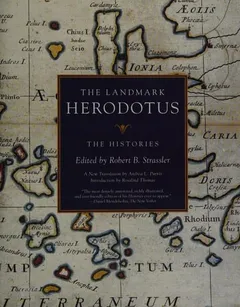
We recommendThe Landmark Thucydides, translated by Richard Crawley, edited by Robert B. StrasslerFree Press, 2008The Crawley text with maps on nearly every page, marginal summaries and appendices that make the campaigns followable.
Also good
- Rex Warner. The smoothest modern prose version, and the cheapest way to read it straight through.
- Jeremy Mynott. The most accurate recent translation, with notes that flag where the Greek is genuinely obscure.
These links go straight to Amazon and Bookshop.org and earn this site nothing today. Prices are the same either way. How this works.
An account of the war between Athens and Sparta from 431 BCE to 411, where the text breaks off in mid-sentence, written by an Athenian general exiled after failing to save Amphipolis. Thucydides explains the war's real cause as the growth of Athenian power and the fear it produced in Sparta, and narrates the plague at Athens, Pericles' funeral oration, the debate over the punishment of Mytilene, the civil war at Corcyra, the massacre at Melos and the destruction of the Athenian fleet and army in Sicily. He wrote, he says, not to win a prize but to be useful to anyone facing the same situation again.
Why it's on the list
Thucydides invented the idea that a war can be explained rather than merely commemorated. He removed the gods from causation, separated what people said from what they did, and left the speeches in so that readers could watch arguments fail in real time. The result founded political history and, by accident, the discipline of international relations, where his sentence about power and fear is still quoted in policy papers. Programs assign him alongside Plato because the two are answering the same city from opposite directions: Thucydides shows a democracy talking itself into catastrophe, and Plato asks what kind of soul would have known better. The book is also the earliest clear-eyed study of how political language rots during a civil war, and nothing written since has improved on it.
Key themes
- Power and authority
- Thucydides distinguishes the grievances states announce from the structural fear that actually moves them, and he trusts the second.
- War
- The war is shown as a system that outlasts the men who start it. Each escalation is reasonable and the sum of them is ruinous.
- Language and rhetoric
- Almost a quarter of the text is speeches. At Corcyra Thucydides records political vocabulary being deliberately corrupted, so that recklessness gets called courage.
- Justice
- Justice appears mainly as something the weak invoke and the strong decline to discuss. Whether the author approves is left for the reader to decide.
- Society and the state
- The plague and the Corcyra revolution are placed early and studied in the same way, as descriptions of what happens when the restraints on people fail.
Overview
Eight books, unfinished, and the division into books was done by someone else later. The narrative stops in the middle of the twenty-first year of a twenty-seven-year war, mid-sentence, in the autumn of 411 BCE. Thucydides tells us in Book 5 that he lived to see the end and Athens defeated, so the incompleteness is a matter of writing, not of knowledge, and nobody knows why he stopped.
The book alternates between two modes. One is a dry campaign chronicle organised by summer and winter, full of place names, troop numbers and small sieges. The other consists of set pieces: long paired speeches, and a handful of analytical essays on the plague, on civil war, on the Athenian character. The set pieces are what everyone remembers. The chronicle is what gives them weight, because it shows you how ordinary the intervals between disasters were.
The speeches are not transcripts, and Thucydides says so in his one methodological paragraph: he gives what the situation demanded, keeping as close as he could to the sense of what was actually said. This is the most argued-over sentence in ancient historiography. Treat the speeches as the best available reconstruction of the reasoning on each side, not as quotation.
One more thing to know going in. Thucydides was a participant. He commanded in the north, lost Amphipolis to the Spartan general Brasidas in 424, and spent twenty years in exile, which he notes gave him access to both sides. He never defends himself.
What happens
Book 1 supplies the background: a compressed history of early Greece, the growth of the Athenian empire out of the Persian wars, the quarrels over Epidamnus and Potidaea that gave both sides their pretexts, and the debates at Sparta and Athens. Pericles argues that Athens should not yield to an ultimatum.
Books 2 and 3 cover the first years. The Thebans attack Plataea. Pericles delivers the funeral oration over the first year’s dead, describing a city worth dying for, and Thucydides follows it immediately with the plague, which kills perhaps a third of the population and Pericles himself. Then Mytilene revolts, and the Athenian assembly votes to kill every adult male, reverses itself the next day after a debate between Cleon and Diodotus, and sends a second ship to overtake the first. Corcyra tears itself apart in a class war, and Thucydides pauses to generalise.
Books 4 and 5 bring a stalemate, the Athenian success at Pylos, the loss of Amphipolis, the deaths of Brasidas and Cleon in the same battle, and the Peace of Nicias in 421, which nobody observes. In the middle of the uneasy peace, Athens demands the submission of Melos, a small neutral island, and the two sides hold the dialogue in which the Athenians argue that questions of right only arise between equals. Melos refuses, is besieged, and its men are killed and its women and children sold.
Books 6 and 7 are the Sicilian expedition. Athens is persuaded by Alcibiades to send a fleet against Syracuse, a city as large as itself, on the far side of the Greek world. Alcibiades is recalled to face a religious charge, defects to Sparta, and advises them. Nicias, who opposed the expedition, ends up commanding it, delays after an eclipse frightens his men, and loses the fleet in the harbour and the army on the retreat. Thucydides describes the last days with a plainness he uses nowhere else.
Book 8 covers the aftermath: revolts in the empire, Persian money entering the war, the oligarchic coup of the Four Hundred at Athens, and then the text stops.
How to read it
Get an edition with maps and use them. More readers give up on Thucydides for geographical reasons than for any other.
Read the speeches in their pairs. The Mytilenian debate, the Melian dialogue and the exchange between Nicias and Alcibiades over Sicily are the heart of the book, and each is designed so that the worse argument is the more persuasive one.
You may skim the minor campaigns on a first reading, but do not skip the plague in Book 2 or the Corcyra analysis in Book 3. They are the book’s theory of politics, stated in the form of case notes.
Resist the temptation to make Thucydides a cynic. He never says might is right; he puts that argument in the mouths of envoys and then shows Athens destroyed within a decade. He also never says the destruction was punishment. Working out what he does think is the whole exercise.
Questions it raises
- If the growth of Athenian power made war inevitable, what were all the debates for?
- Is the funeral oration Thucydides’ own view of Athens, or an exhibit placed next to the plague for contrast?
- The Melian dialogue is the only extended dialogue in the book. Why did he write that scene in that form?
- Was the Sicilian expedition a bad plan or a good plan badly executed? Thucydides seems to say both.
- What does it mean that a historian who removed the gods still writes as though Athens was destroyed by its own character?
- Can a war narrative that stops seven years early still be the book he said he was writing?
Highlights
The real cause I consider to be the one which was formally most kept out of sight. The growth of the power of Athens, and the alarm which this inspired in Lacedaemon, made war inevitable.
The most quoted sentence in the study of international politics.
For heroes have the whole earth for their tomb.
From the funeral oration, delivered a few pages before the plague arrives.
The strong do what they can and the weak suffer what they must.
The Athenian envoys at Melos, refusing to let the argument be about justice at all.
At Corcyra, Thucydides writes, words changed their meanings: reckless daring passed for courage, prudent hesitation for cowardice, and moderation for a cover for weakness.
Paraphrase.
Of the Athenian force in Sicily, he says, few out of many came home, and this was the greatest action of the war and the most calamitous ever suffered by Greeks.
Paraphrase.