The Constitution of the United States
by Anonymous
Assigned by 7 of the 9 reading lists
- Written
- 1787, amended from 1791
- Language
- English
- Length
- Short · 40 ppunder 120 pages
- Difficulty
- Moderate2 of 5 for a first-year reader
We recommendThe Constitution of the United States of America, with the Declaration of IndependencePenguin Civic Classics, 2012Cheap, complete with all amendments, and includes the Declaration most programs pair with it.
Also good
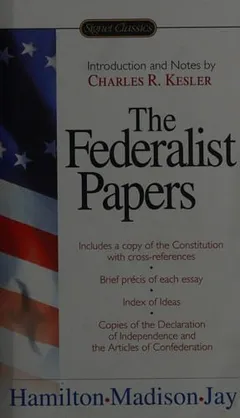
- Signet Classics. Prints the Constitution as an appendix and supplies the argument its authors made for ratifying it.
- Signet Classics. The case against, plus Madison's notes from the Convention, which show what was traded away.
These links go straight to Amazon and Bookshop.org and earn this site nothing today. Prices are the same either way. How this works.
Drafted at Philadelphia over four months in 1787 by delegates sent to repair the Articles of Confederation, and ratified state by state over the following year, the Constitution created a federal government of enumerated powers divided among three branches. Seven articles set out the legislative power of a bicameral Congress, the executive power of a President chosen by electors, a judiciary whose jurisdiction Congress largely defines, the obligations states owe each other, the procedure for amendment, the supremacy of federal law, and the terms of ratification. Ten amendments guaranteeing individual liberties followed in 1791. Seventeen more have been added since, three of them to end slavery and secure the rights of the freed.
Why it's on the list
It is the oldest written national constitution still in force, and the model that most later ones either copied or reacted against. Its central wager is that liberty is protected less by declarations than by structure: divide power, give each holder of it an interest in checking the others, and make amendment hard. That wager is still being tested, and every serious argument in American public life is conducted in the document's vocabulary. It is also a compromise with slavery that cost six hundred thousand lives to undo, and reading the three-fifths clause and the fugitive slave clause in the original text is the fastest way to understand why abolitionists disagreed about whether the thing could be saved. Programs assign it because it is the rare political theory that had to be built and run.
Key themes
- Power and authority
- Powers are enumerated rather than granted in general terms, so the recurring question is what the necessary and proper clause lets Congress add.
- Liberty and rights
- The original text protects freedom mainly through procedure and structure. The Bill of Rights was added because that was not thought to be enough.
- Society and the state
- Sovereignty is split between nation and states in a way the document never fully defines, which is the unresolved question underneath the Civil War.
- Justice
- The clauses on representation, the slave trade and fugitives from labour are the price of ratification, written in careful language that avoids the word slave.
Overview
The Constitution is about forty-five hundred words in its original form, shorter than many of the essays written to defend it, and the whole thing plus every amendment fits in a pocket pamphlet. It is worth knowing how little of it there is, because the brevity is a choice. The document sets up offices, says how they are filled, lists what they may do, and stops. It does not explain itself, define most of its key terms, or say who decides when its provisions conflict.
Structurally it is a set of instructions. Seven articles, each divided into sections and clauses, followed by twenty-seven amendments printed in the order of their adoption. Citations look like Article I, Section 8, Clause 3, which is the commerce clause, or Amendment XIV, Section 1, which contains due process and equal protection. Learning to navigate by those coordinates is most of what reading the text well requires.
It has no author. Fifty-five delegates attended the Philadelphia Convention, thirty-nine signed, and the drafting committee’s stylist was Gouverneur Morris, who wrote the Preamble as we have it. Madison’s private notes are the main record of the debates, which were held in secret. The document that emerged is a bundle of compromises, and it reads like one: places where the language is precise are usually places where precision was cheap, and places where it is vague are usually where agreement was not available.
The argument
The case the document makes is structural rather than stated. Its premise, defended at length in the Federalist, is that people in power will pursue their own interest, and that the remedy is not better people but an arrangement in which ambition is set against ambition.
Article I builds the legislature and is by far the longest. Two chambers with different terms, sizes and constituencies must agree before anything becomes law. Section 8 enumerates the powers: taxation, borrowing, regulating commerce among the states, coining money, declaring war, raising armies, and at the end the authority to make all laws necessary and proper for carrying the rest into execution. Section 9 lists what Congress may not do, including passing bills of attainder or suspending habeas corpus except in emergency. It also forbade any ban on the slave trade before 1808.
Article II creates a single executive, chosen by electors rather than by Congress or by direct vote, with a four-year term and no original limit on re-election. The powers are sparse: command of the armed forces, appointment and treaty-making with Senate consent, a duty to see the laws faithfully executed. What a President may do beyond this has been contested since Washington.
Article III is the shortest and the most consequential for what it leaves out. It establishes one Supreme Court, allows Congress to create the rest, gives judges tenure during good behaviour, and defines the categories of case the federal courts may hear. It says nothing about striking down statutes. Judicial review is an inference the Court drew for itself in 1803, and whether the inference is sound is a live question.
Article IV governs the states: full faith and credit to each other’s records, privileges and immunities for citizens travelling between them, admission of new states, and, in language that avoids the word, the return of fugitive slaves. Article V sets the amendment procedure, requiring two thirds of both houses or of the states to propose and three quarters of the states to ratify, which is deliberately near-prohibitive. Article VI makes federal law supreme and bars religious tests for office. Article VII set ratification at nine states.
The Bill of Rights followed in 1791 because several states ratified on the understanding that it would. The first eight list individual protections, the Ninth says the enumeration does not exhaust rights, and the Tenth reserves undelegated powers to the states or the people. The Reconstruction amendments of 1865 to 1870 abolished slavery, made citizenship national and imposed due process and equal protection on the states, and barred racial exclusion from voting. Later amendments brought the income tax, direct election of senators, prohibition and its repeal, women’s suffrage, presidential term limits and the vote at eighteen.
How to read it
Read the whole thing straight through once. It takes half an hour and almost nobody does it, which is why so much argument about it proceeds from half-remembered summaries.
Then read Article I Section 8 and Article I Section 9 side by side, since together they are the map of federal power. Then Amendment XIV Section 1, which is the single most litigated sentence in American law. Then Article V, and ask yourself what the difficulty of amendment does to a country that cannot change its founding text and therefore changes its interpretation instead.
Notice the silences. There is no mention of political parties, of judicial review, of the cabinet, of the primary, of corporations, or of a right to vote stated positively. Much of the working constitution is convention built on top of the text.
Notice the euphemisms. The word slavery appears nowhere before the Thirteenth Amendment. The three-fifths clause says “three fifths of all other Persons”; the fugitive clause says “Person held to Service or Labour”. Reading those clauses in the original wording tells you something a summary cannot.
Pair it with something. The Declaration for the premises, the Federalist for the defence, the Anti-Federalist writings for the objections that produced the Bill of Rights. Reading it alone makes it look inevitable, which is the one thing it was not.
Questions it raises
- Article III never grants the power to void a statute. Where does judicial review come from, and should it exist?
- If amendment is nearly impossible, does interpretation become the real amendment process, and who is doing the amending?
- The Preamble says the People ordain the document, but ratification ran through state conventions. Who is the constituting authority?
- Can a founding text that protected slavery for seventy-four years be described as an instrument of liberty?
- The necessary and proper clause could authorise almost anything or almost nothing. What decides?
- What holds the system together when the branches simply refuse to check each other?
Highlights
We the People of the United States, in order to form a more perfect Union, establish Justice, insure domestic Tranquility, provide for the common defence, promote the general Welfare, and secure the Blessings of Liberty to ourselves and our Posterity, do ordain and establish this Constitution for the United States of America.
Note who is speaking. The Articles of Confederation had been a compact among states.
All legislative Powers herein granted shall be vested in a Congress of the United States, which shall consist of a Senate and House of Representatives.
Herein granted is the crucial qualifier. Congress has the powers listed and, in principle, no others.
Congress shall make no law respecting an establishment of religion, or prohibiting the free exercise thereof; or abridging the freedom of speech, or of the press; or the right of the people peaceably to assemble, and to petition the Government for a redress of grievances.
Six guarantees in one sentence, addressed to Congress alone until the Fourteenth Amendment changed that.
This Constitution, and the Laws of the United States which shall be made in Pursuance thereof, shall be the supreme Law of the Land.
The supremacy clause, which turns a federation of states into a government with direct authority over individuals.
Neither slavery nor involuntary servitude, except as a punishment for crime whereof the party shall have been duly convicted, shall exist within the United States.
Read the exception clause carefully. It has a long afterlife in American prison labour.